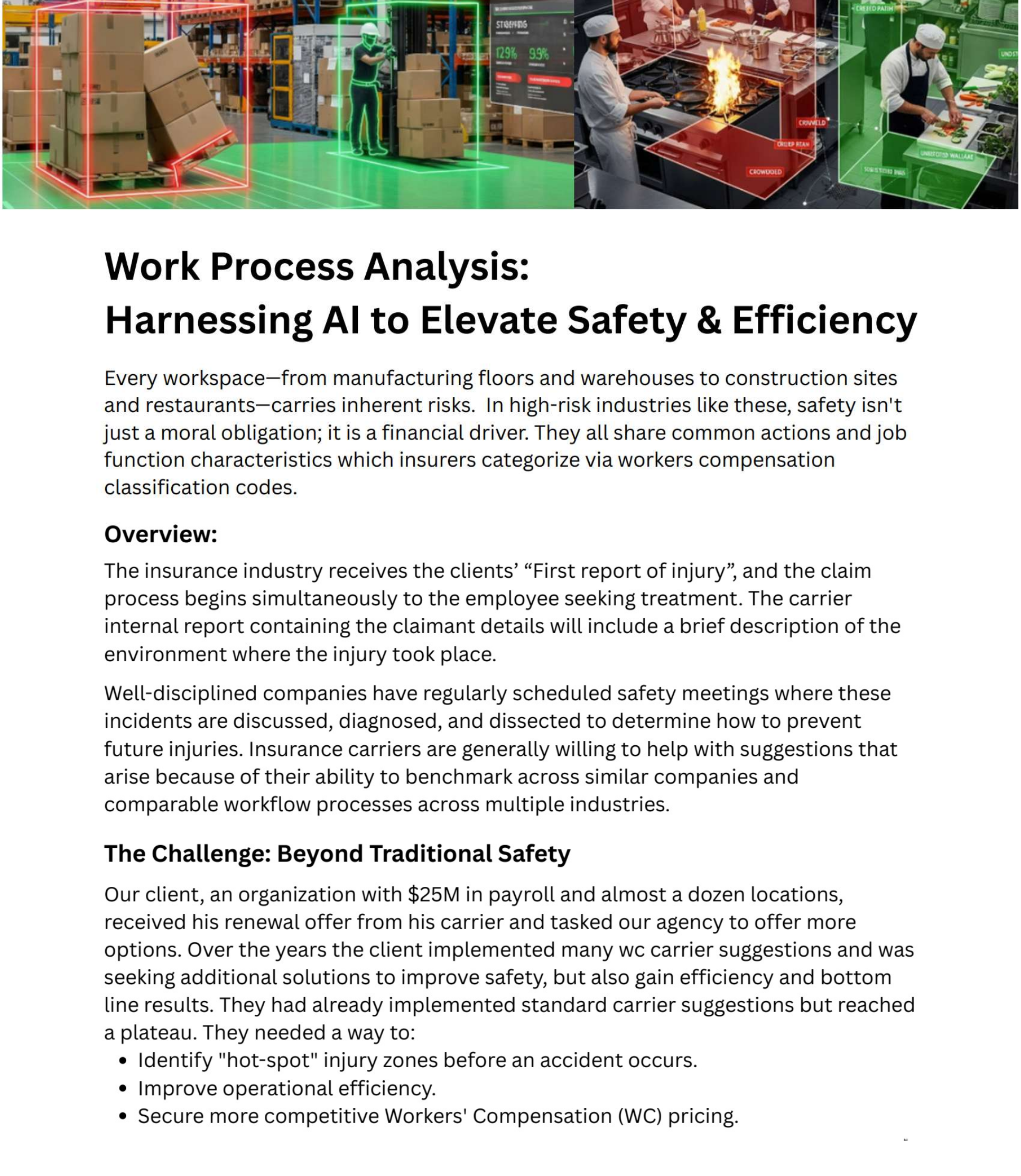
Every workspace- from manufacturing floors and warehouses to construction sites and restaurants- carries inherent risks. In high-risk industries like these, safety isn’t just a moral obligation; it is a financial driver. They all share common actions and job function characteristics which insurers categorize via workers compensation classification codes.
Overview:
The insurance industry receives clients’ “First Report of Injury”, and the claim process begins simultaneously to the employee seeking treatment. The carrier internal report containing the claimant details will include a brief description of the environment where the injury took place.
Well-disciplined companies have regularly scheduled safety meetings where these incidents are discussed, diagnosed, and dissected to determine how to prevent future injuries. Insurance carriers are generally willing to help with suggestions that arise because of their ability to benchmark across similar companies and comparable workflow processes. Across multiple industries.
The Challenge: Beyond Traditional Safety
Our client, an organization with $25 million in payroll in almost a dozen locations, received his renewal offer from his carrier and tasked our agency to offer more options. Over the years the client implemented many wc carrier suggestions and was seeking additional solutions to improve safety, but also gain efficiency and bottom line results. They had already implemented standard carrier suggestions but reached a plateau. They needed a way to:
1) Identify hot spot injury zones before an accident occurs
2) Improve operational efficiency
3) Secure a more competitive workers compensation premium pricing.
The Innovation: Polestar’s AI Work Process Analysi
While the traditional insurance industry has long relied on standard classification codes and historical claim data or First Report of Injury to track injuries and claims (data that only exists because someone is already injured or hurt), Polestar is moving beyond reactive reporting to proactive prevention by introducing cutting edge Work Process Analysis AI.
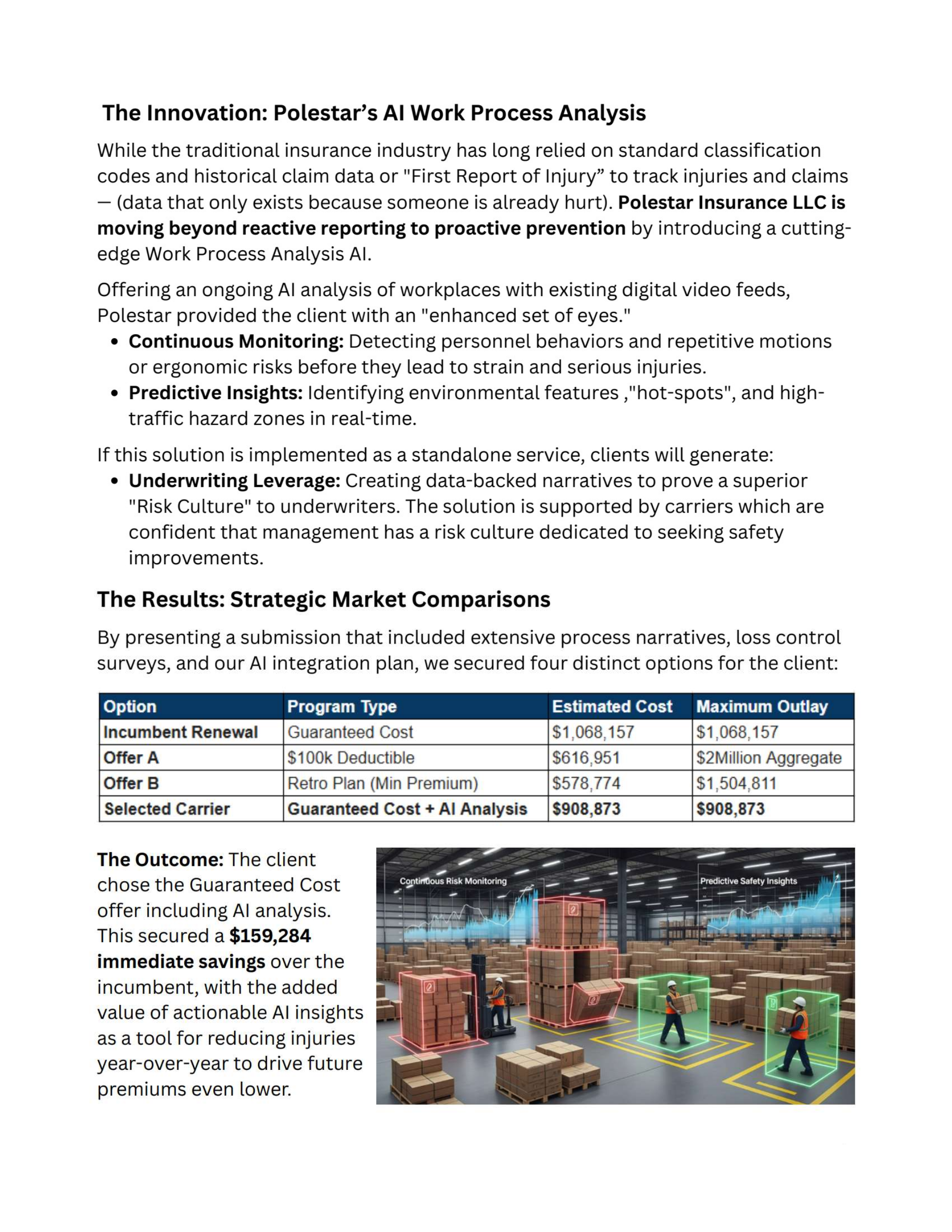
Offering an ongoing AI analysis of workplaces with existing digital video feeds, Polestar provided the client with an “enhanced set of eyes.”
• Continuous monitoring: detecting personnel behaviors and repetitive motions or ergonomic risks before they lead to strain and serious injuries.
•Predictive insights: identifying environmental features, hot-spots and high-traffic hazard zones in real time.
If this solution is implemented as a stand-alone service clients will generate
• Underwriting leverage: creating a data-backed narrative to prove a superior “risk culture” to underwriters. The solution is supported by carriers which see the management has a risk culture dedicated to seeking safety improvements.
The Results: Strategic Market Comparisons
By presenting a submission that included extensive process narratives, loss control surveys, and our AI integration plan, Polestar secured four distinct options for the client to consider:
a) Incumbent: Guaranteed Cost $1,068,157
b) Offer A $100,000 deductible $ 616,951 ($2 mill aggregate)
c) Offer B Retro Plan (min prem) $ 578,774 ($1,504,811 max outlay)
d) Offer C GC with AI Analysis $ 908,873
The Outcome
The client chose the guaranteed cost offer including the AI Analysis. This secured $159,284 immediate savings over the incumbent, with the added value of actionable AI insights as a tool for reducing injuries year-over-year to drive future premiums even lower.
The Polestar Advantage
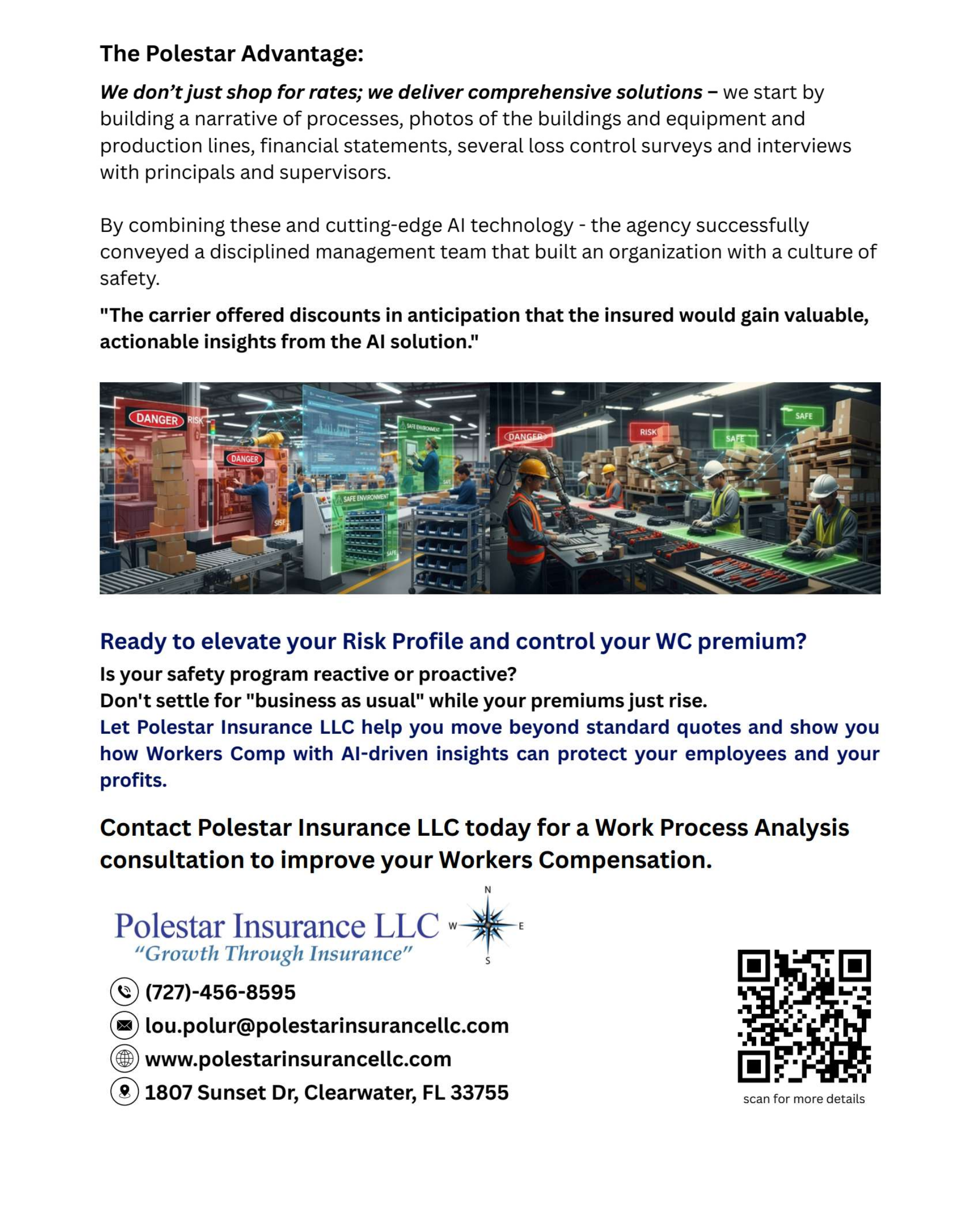
We don’t just shop for rates- we deliver comprehensive solutions for our clients. This client benefited because we conveyed a highly disciplined management team that built an organization with a culture of safety to our insurance underwriters. We partner both with the client and the carrier.
Our client’s underwriter said “the carrier offered discounts in anticipation that the insured would gain valuable, actionable insights from the AI solution.”
